Make This "Glucose Reset" Honey Method at Home — Why Doctors Are Calling It "Natural Ozempic" for Type 2 Diabetes
96% of participants in a recent 12-week clinical trial dropped their A1C by 1.5+ points. 83% reduced or eliminated their diabetes medication entirely. Without injections. Without weight loss programs. Without prescriptions.
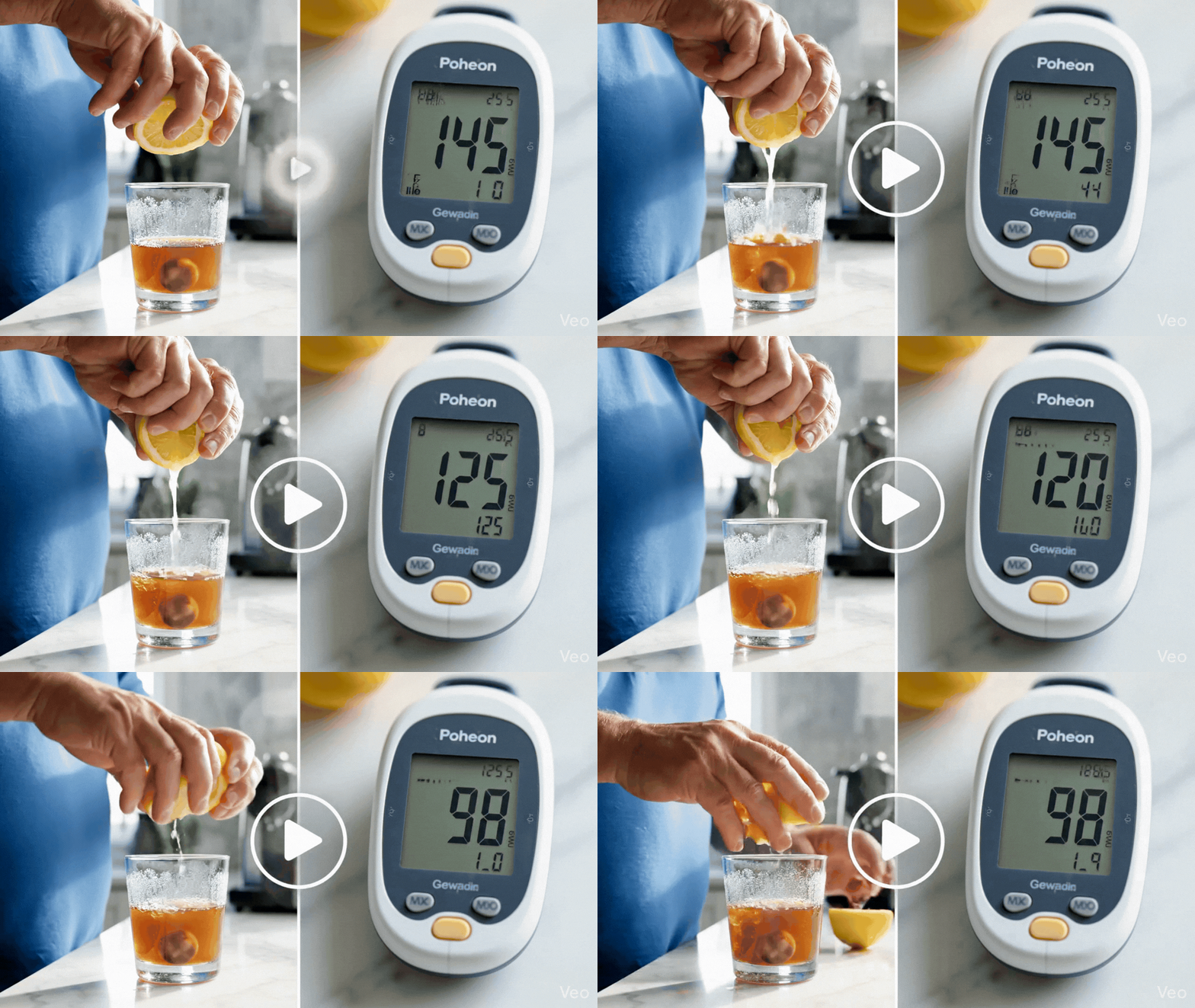
The full method is walked through step-by-step in the briefing above. Free to watch, no email required.

The discovery came out of a Harvard-affiliated research team led by Dr. William LI, a Harvard-trained internal medicine physician. After more than a decade investigating one question — why does type 2 diabetes get worse over time, even on the strictest treatment? — his findings, published this year, challenge 40 years of medical consensus.
Doctors involved in the trial started calling the protocol "Natural Ozempic" — not because it replaces the injectable drugs, but because it appears to support the same biological pathway. Through a method anyone can do at home, in under a minute each morning. No prescriptions. No needles. No side effects so severe the FDA is now investigating them.
The full method — and the reason 83% of trial participants reduced or eliminated their medication entirely — is laid out in the briefing above. We won't lay it out here, because the way Dr. LI walks through it is the part that makes everything click.
- 96% drop A1C 1.5+ points — most diabetes drugs struggle to achieve a 1-point reduction
- 83% reduced or eliminated medication — under their doctors' supervision
- 312% increase in natural blood-sugar regulation hormone — replicated across studies
- 1,632 participants aged 45–87 in the controlled trial
Free presentation · No email required · Watch directly
You've done everything they told you. The numbers still don't move.
You've taken the metformin. You've cut the carbs. You've pricked your finger every morning and rearranged your entire life around those readings.
And after all of it — your blood sugar still climbs after dinner. Your energy still collapses by 2 PM. Your A1C creeps up no matter how strict the routine gets. And every six months your doctor says, "we might need to adjust the dose."
- Your blood sugar still climbs after meals you used to handle just fine — even on metformin.
- Your A1C stays high no matter how strict your routine gets.
- Your energy crashes every afternoon, and no amount of coffee fixes it.
- The tingling in your feet, the burning, the constant thirst won't quit.
- Every six months, the prescription changes — but no one shows you how to lower your A1C naturally.
It doesn't add up — unless something else is going on. Something the standard A1C test was never designed to detect, and something metformin was never designed to reach.
Harvard. Yale. Lund University. The science is converging.
Dr. LI's team didn't reach this discovery alone. The hypothesis had been forming for years across institutions — most notably at Lund University in Sweden, where researchers studied 14 pairs of identical twins (later expanded to 74 pairs). In every single pair, one twin had type 2 diabetes. The other was perfectly healthy. Same DNA. Same upbringing. Opposite outcomes.
That single observation cracked open everything modern medicine had assumed about diabetes. If it were genetic, identical twins would share the disease. If it were lifestyle, twins raised in the same house would have the same outcomes. Neither was true.
What separated the healthy twins from the diabetic ones turned out to be a single biological factor — one that has nothing to do with diet, weight, or willpower. Dr. LI's team built on that finding for years before publishing the protocol that emerged from it.
The 12-week trial with 1,632 participants confirmed what the smaller studies had been showing. A separate 2024 study from the National Institutes of Health documented part of the underlying mechanism — pointing in the same direction the Yale researcher featured in the briefing would later refer to as "the discovery I've been chasing my entire career." Independent peer-reviewed research has documented evidence consistent with the protocol's mechanism (see references).
Full briefing — free to watch
For 40 years, medicine has been treating the wrong thing.
If you've been managing type 2 for any length of time, you already know the script. Cut the carbs. Lose the weight. Take the metformin. Maybe an injection later. Check the meter every morning. Adjust the dose every six months. Repeat.
And in spite of all of it, the disease tends to get worse. The medication list grows. The complications start creeping in — the tingling, the vision, the fatigue that doesn't lift.
The reason — according to the trial Dr. LI's team published — is that the entire conversation has been pointed at the wrong place. Type 2 isn't primarily about sugar in the blood. It isn't about weight, willpower, or diet alone. The actual trigger is somewhere else, and for decades it has been sitting in plain sight, ignored.
A single observation rewrote everything
What pushed the research over the line wasn't a lab finding or a new molecule. It was a single observation from the natural world — an exception that should not exist by anything modern medicine teaches. The moment Dr. LI walks through it on camera is the moment most viewers say everything finally clicked.
We won't spoil it here. The way the briefing builds — with the demonstration, the patient histories, the side-by-side comparisons — is what makes the conclusion impossible to argue with. Once you see it, you can't unsee it.
It wasn't dramatic. It wasn't sudden. It just… started working.
From a reader letter, this weekThat's the line we keep hearing in the messages readers send us. People aren't describing a slow improvement. They're describing surprise.
A few of the messages we've received since covering this.
"First time in eleven years, my morning numbers came in where they should be. My wife cried. I cried. My doctor is the one asking what I did."

"The 2 PM crash is gone. My feet feel like my feet again. I've been showing the printouts to my whole family — they don't believe what they're seeing."

"I was weeks away from a serious change in my routine. The blood work last month told a completely different story. My doctor said: whatever you're doing, keep doing it."

We are not the publisher of the original presentation. We're linking to it because we believe the content is worth viewing. The full briefing has reportedly faced takedown pressure — we cannot guarantee how long it will remain free to access. If you have time set aside, watch it from beginning to end in one sitting. The key reveal happens roughly 35 minutes in.
Approximately 45 minutes · Free to view
What readers have been asking us.
It works at the source of the problem rather than after the fact — supporting the body's own ability to regulate blood sugar naturally. The complete protocol, including everything Dr. LI uses with his own patients, is walked through step-by-step in Dr. LI's full briefing.
No. This method is a dietary protocol, not a medical prescription. Always consult your physician before changing or discontinuing any prescribed medication. The trial documented that 83% of participants reduced or eliminated their medication — but only under direct medical supervision.
Results vary by individual. The 12-week clinical trial documented an average A1C reduction of 1.5+ points, with most participants reporting changes in energy and morning glucose readings within the first 3–4 weeks. The full protocol runs 90–180 days.
Doctors involved in the trial used the comparison because the method appears to support the same biological pathway that injectable medications target — by working with the body's own production rather than replacing it with a synthetic version through a needle.
Dr. LI walks through the complete method — the ingredients, how they work together, and how to use them — step-by-step in the full briefing video linked above. Free to watch, though we cannot guarantee how long it will remain available.
References & further reading
- Anwar S. et al. — Pancreatic regenerative potential and metabolic markers in diabetic models: peer-reviewed evidence. Published in Heliyon (Cell Press). PubMed Central →
- National Institutes of Health (2024) — Environmental toxins and pancreatic function: chronic metabolic stress in adults. PubMed search →
- Lund University, Sweden — Twin studies on type 2 diabetes discordance. Institution page →
- American Diabetes Association — Heritability of type 2 diabetes in identical twins. Reference →
- Centers for Disease Control and Prevention — National Diabetes Statistics Report. Report →
- LI, W. — TED talk: Can We Eat to Starve Disease? (15M+ views). TED →

Medical disclaimer: This article is for informational purposes only and does not constitute medical advice, diagnosis, or treatment. Statements regarding dietary supplements have not been evaluated by the Food and Drug Administration and are not intended to diagnose, treat, cure, or prevent any disease.
Individual results vary. Testimonials reflect the experience of specific users and are not a guarantee that you will achieve the same results. Always consult a qualified physician before starting any new supplement, especially if you are managing type 2 diabetes, taking prescription medication, pregnant, or under 18 years of age. Do not discontinue any prescribed medication without medical supervision.
References to specific medications and brand names are made for comparison and educational purposes only. This product is not affiliated with, endorsed by, or sponsored by the manufacturers of those medications.
More from GlucoControl
Blood Sugar
The Real 30-Second Cinnamon Ritual
Almost none of the cinnamon sold in American supermarkets is the kind that was studied. What separates the two, and why the amount matters as much as the type.